











Amex Merchant Fees: What Merchants Pay and Why
Amex merchant fees sit outside the European interchange caps that keep Visa and Mastercard costs low: American Express runs a closed-loop network and sets its own merchant rates, officially from a promotional 0% up to 4% for small merchants. This guide explains what UK and EU merchants pay, the acceptance rules and how to cut card costs.
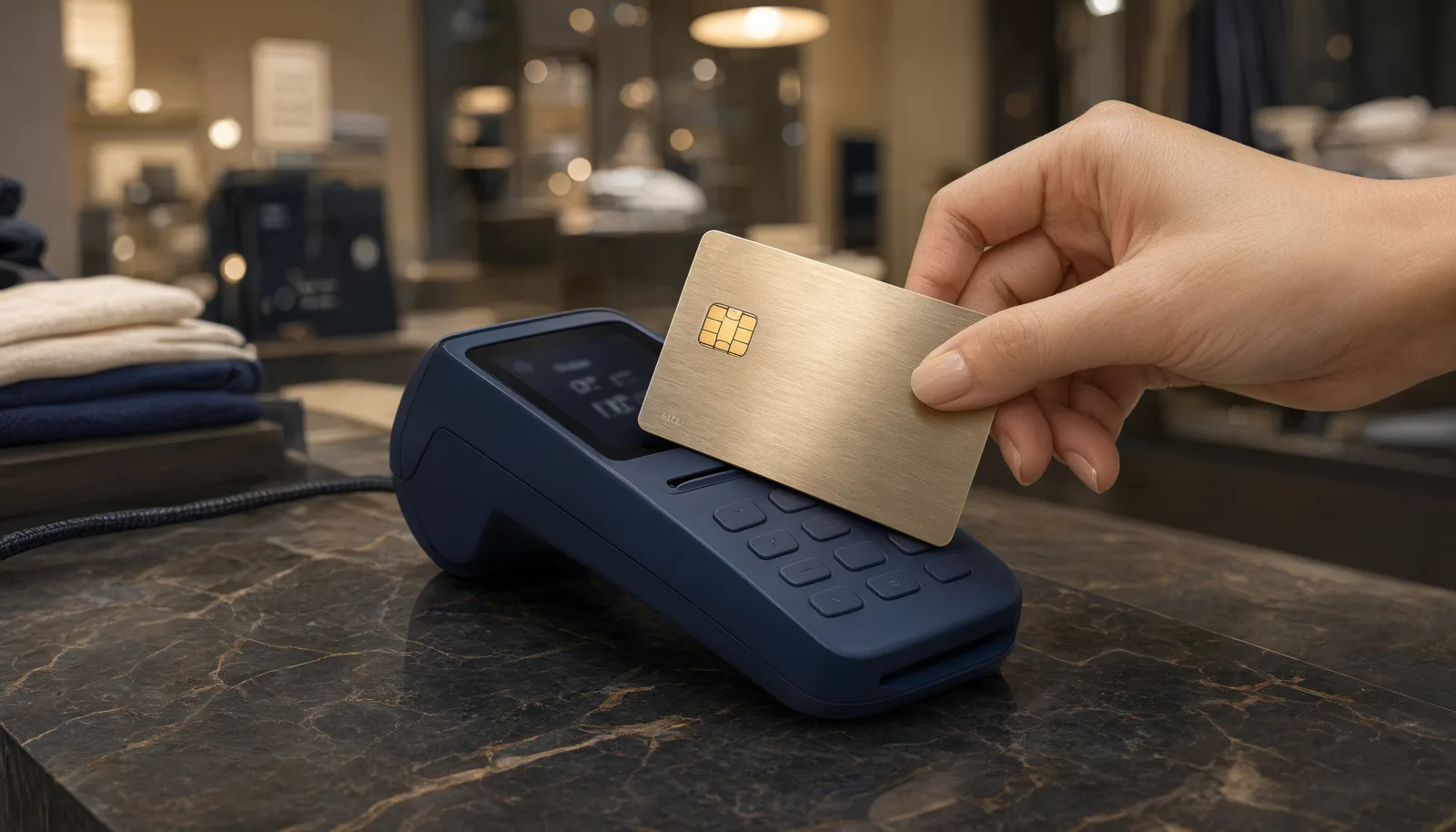
Why Amex merchant fees are different: the closed-loop model
Visa and Mastercard are four-party schemes: the customer's issuer, the merchant's acquirer, the network and the processor are separate entities, and interchange flows between banks. Regulation (EU) 2015/751 caps consumer interchange by law at 0.2% on debit cards and 0.3% on credit cards.
American Express works differently: it is a closed-loop network where the same company issues the card, operates the rails and bills the merchant. There is no interchange between separate banks, so the European cap does not apply and Amex merchant fees are negotiated freely with each business. This is the structural reason why accepting an Amex card typically costs a merchant more than a Visa or Mastercard of equivalent volume.
How much does American Express charge merchants?
The public reference is American Express itself: on its Italian merchant page the network publishes indicative fees from a promotional 0% up to a maximum of 4% for small merchants, with rates depending on sector, volume and contract terms. The wide range reflects the absence of a regulatory cap like the one governing Visa and Mastercard.
The fair comparison is with the full cost of a four-party card. On Visa and Mastercard a European merchant pays regulated interchange (0.2% debit, 0.3% credit), the scheme fee and the provider markup: three separate, verifiable items, as explained in our guide to [interchange fees](/en/resources/what-are-interchange-fees-how-they-work). On Amex the merchant pays one negotiated rate that bundles everything. A business taking 10,000 euros per month through Amex at 2-3% pays 200-300 euros per month for that scheme alone, against a few decimal points of variable cost on a European debit card.
Acceptance obligations and surcharge rules
Three principles frame the legal side. Acceptance duty: several European markets oblige merchants to accept electronic payments, with fines for refusal such as the 30 euro penalty introduced in Italy by the 2022 Budget Law, but no rule forces the merchant to enable a specific scheme, so switching on Amex stays a contractual choice.
No surcharge: in the EU the PSD2 directive (EU) 2015/2366 bans extra fees on consumer card payments, American Express included; in the UK the same prohibition comes from the Payment Services Regulations 2017, in force since 13 January 2018. The higher scheme cost cannot be passed to the customer.
Contract transparency: check Amex conditions in your acquiring contract, including settlement times and dispute channels, which in a closed-loop follow the network's own procedures rather than the four-party rulebook.
When accepting American Express makes sense
Three numbers decide. Amex share of your revenue: if a meaningful slice of your best customers pays with Amex, refusing the scheme means losing sales. Hotels, luxury retail, high-end dining and B2B tend to see higher Amex shares than neighbourhood retail.
Average ticket: on a large ticket the percentage difference is significant in absolute terms, but the absolute margin of the sale often absorbs it. On repeated micro-tickets the relative cost weighs more.
Sales margin: the practical test is (average ticket x margin %) against (average ticket x Amex fee). If the fee eats a minority of the margin, accepting widens your customer base. If your mix is dominated by consumer debit cards, your fee budget works harder elsewhere.
Cutting total card costs with transparent IC++ pricing
The Amex rate is negotiated with the network, but the bigger saving for a European merchant sits in optimising the four-party schemes, where transparency is guaranteed by regulation. With IC++ pricing every component is itemised: RoxPay charges €0.15 + 0.35% to 0.85% (IC++) on Visa and Mastercard cards, with interchange and scheme fees shown at real cost on the statement.
To size the difference on your volume, our guide to [calculating payment fees with the IC++ model](/en/resources/calculating-payment-fees-ic-plus-plus) walks through the numeric comparison with flat rates. The second saving lever is monitoring scheme fees, the network charges that often stay hidden inside blended contracts. A transparent statement on Visa and Mastercard, combined with a deliberate decision on your Amex share, covers both sides of the cost equation.
Frequently Asked Questions
Why are Amex merchant fees higher than Visa and Mastercard?
American Express is a closed-loop network: the same company issues the card, runs the network and collects from the merchant, so no interchange passes between separate banks. Regulation (EU) 2015/751, which caps consumer interchange at 0.2% for debit and 0.3% for credit, applies to four-party schemes like Visa and Mastercard, not to Amex, which negotiates its merchant rate freely.
How much does American Express charge merchants?
On its Italian merchant page American Express publishes indicative rates from a promotional 0% up to a maximum of 4% for small merchants, depending on sector and contract terms. Rates are negotiated individually and are not subject to the European interchange caps that apply to Visa and Mastercard.
Do I have to accept American Express?
Accepting electronic payments is mandatory in several European markets, with fines for refusing card payments such as the 30 euro penalty introduced in Italy by the 2022 Budget Law, but no rule forces a merchant to enable a specific scheme. Switching on American Express remains a commercial decision based on your customer base and volumes.
Can I charge customers extra for paying with Amex?
No. In the EU, the PSD2 directive (EU) 2015/2366 bans surcharges on consumer card payments for every scheme, American Express included. In the UK the same prohibition comes from the Payment Services Regulations 2017, in force since 13 January 2018. The higher scheme cost stays with the merchant.
You might also like
High Risk Payment Gateway
Secure payment processing for high-risk industries with multi-acquirer routing and chargeback protection.
Small Business Payment Solutions
Transparent IC++ pricing, free Smart POS terminal, and 24-hour activation for small businesses.
E-commerce Payment Integrations
One-click plugins for WooCommerce, Magento, and PrestaShop with full API access.
Optimize your payments today
Calculate how much your business saves with RoxPay IC++ pricing versus flat rates. Talk to an expert at /en/contact.
✓ No monthly fixed costs · ✓ Activation in 24 hours · ✓ Dedicated technical support