











Instalment Payments: How They Work and How Merchants Accept Them
Instalment payments split the price of a good or service into scheduled partial payments: the main forms are BNPL (interest-free instalments run by an operator), traditional financing and split cards. For the merchant the customer buys more easily and the fee depends on the chosen plan.
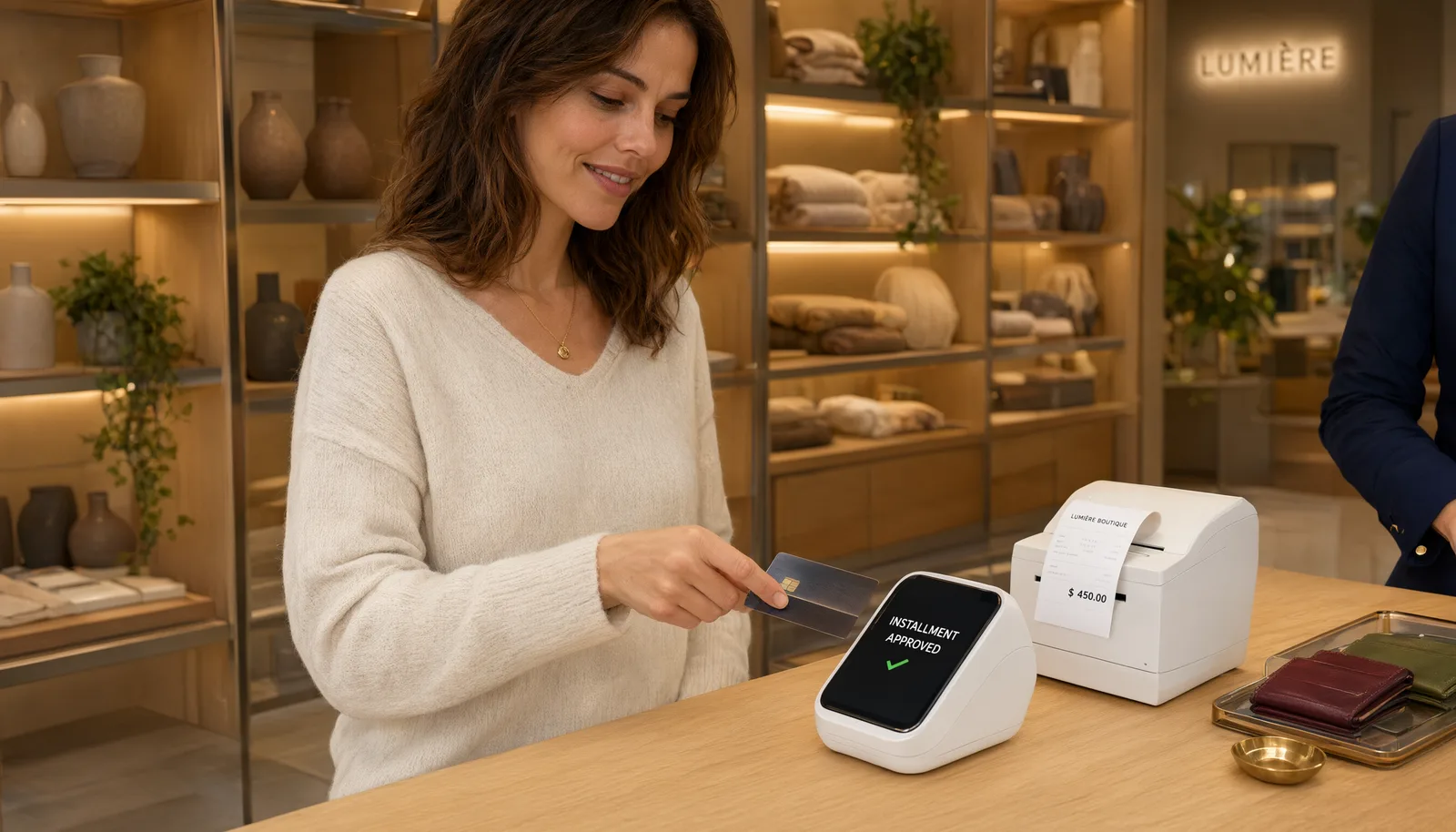
The three forms of instalment payments
| Form | How it works | For the merchant |
|---|---|---|
| BNPL (buy now pay later) | Interest-free instalments (typically 3-12) run by the instalment operator | The operator advances the amount; in the RoxPay list the fee is 5% of the value, in 17 European countries |
| Traditional financing | The bank or finance company grants the loan to the customer and pays the seller | Longer processes, full collection at delivery |
| Split card | The customer's card splits the purchase into instalments internally | For the merchant it is a card payment like any other |
Sources: market provider guides (Klarna, Scalapay, Stripe), RoxPay conditions for the BNPL channel. BNPL is subject to category restrictions and case-by-case evaluation.
What instalment payments mean
An instalment payment is the method by which the customer settles the purchase in several periodic instalments instead of one lump sum: monthly, quarterly or customised per the agreement. The structure lowers the purchase barrier on medium and high amounts, because the customer's cash commitment is spread over time.
The three main forms work very differently. Traditional financing is a loan: the bank assesses the customer and collects the instalments with interest; the seller receives the full amount at delivery. The split card defers everything inside the card product: for the shopkeeper it is a normal card payment. BNPL (buy now pay later) is the new form: a specialised operator pays the merchant upfront and collects the instalments from the customer, interest-free for them, earning from merchant fees or other fees.
The consumer-credit framework applicable to BNPL is EU Directive 2023/2225, detailed in the [buy now pay later guide](/en/resources/buy-now-pay-later).
How the flow works for the merchant
In BNPL the operational flow is simple: at checkout the customer chooses the instalment plan, the operator assesses eligibility in real time and pays the merchant per contract conditions (typically immediately or shortly); the instalments start from the customer. The merchant handles no reminders, missed payments or delays: credit risk passes to the operator.
In physical retail instalments arrive via terminals and dedicated solutions; in the digital channel it is a checkout method of the gateway. With RoxPay the BNPL channel is integrated into the gateway with a fee of 5% of the transaction value, available in 17 European countries, per list conditions.
The practical value for the merchant is measured by market providers: higher average baskets and more conversions on purchases the customer would defer without instalments. The guide on [how e-commerce payments work](/en/resources/ecommerce-payments-explained) places instalments within the checkout flow.
Who pays and how much: fees and requirements
In the BNPL model the fee is typically charged to the merchant, because the commercial benefit (higher basket, more purchases) is theirs. Conditions vary per operator: percentages on volume, fixed shares or mixed schemes. In the RoxPay list the BNPL channel is at 5% of the value; the comparison with the card channel (€0.15 + 0.35-0.85% IC++) shows how heavy the service is: instalments are a sales lever, not the cheapest method per transaction.
Operational requirements: contract with the instalment operator via gateway, merchant eligibility check per category (BNPL is subject to restrictions and case-by-case assessment, as described in the [BNPL guide](/en/resources/buy-now-pay-later)), and checkout configuration.
For recurring term amounts (not one-off) the right lever is SEPA Direct Debit with mandate, as described in the [SEPA Direct Debit for businesses guide](/en/resources/sepa-direct-debit-for-businesses).
Frequently Asked Questions
What do instalment payments mean?
The method by which the buyer settles the amount in several periodic instalments instead of one payment. Main forms: traditional financing (the bank collects the instalments from the customer), split card (the plan is inside the card) and BNPL (an operator pays the merchant and collects the instalments from the customer).
Who pays the instalment fee?
It depends on the form. In BNPL the fee is typically charged to the merchant, who gains in basket size and conversions; in the RoxPay list the BNPL channel is 5% of the transaction value. In traditional financing the cost stays between bank and customer.
Do instalment payments carry interest for the customer?
In BNPL the instalments carry no interest for the customer: the operator funds itself from merchant fees or specific fees. In traditional financing interest exists and is regulated by the consumer credit framework (EU Directive 2023/2225).
Can instalment payments be accepted at the physical POS?
In-store instalments depend on the instalment operator and supported terminals. In the digital channel BNPL is a gateway checkout method: the buy now pay later guide covers activation for the e-commerce channel.
Does RoxPay finance customers directly in instalments?
No. RoxPay is a payment gateway, not a finance company: it integrates the BNPL channel with specialised operators, who assess the customer and manage the instalments. RoxPay is not a bank, does not issue cards and does not open bank accounts.
You might also like
High Risk Payment Gateway
Secure payment processing for high-risk industries with multi-acquirer routing and chargeback protection.
Small Business Payment Solutions
Transparent IC++ pricing, free Smart POS terminal, and 24-hour activation for small businesses.
E-commerce Payment Integrations
One-click plugins for WooCommerce, Magento, and PrestaShop with full API access.
Optimize your payments today
Still unsure which payment gateway to choose? The RoxPay team helps you find the right solution. Contact us at /en/contact.
✓ No monthly fixed costs · ✓ Activation in 24 hours · ✓ Dedicated technical support