











Electronic Receipt: Requirements, Exemptions and Sanctions in 2026
The electronic receipt is the commercial document transmitted electronically to the Italian Revenue Agency: it certifies the sale and the copy delivered by QR code or SMS is valid like the paper receipt (art. 1-bis DL 124/2019). From 1 January 2026 every POS must be linked to the telematic cash register, and sanctions for undocumented revenue start at 90% of VAT with a €500 minimum.
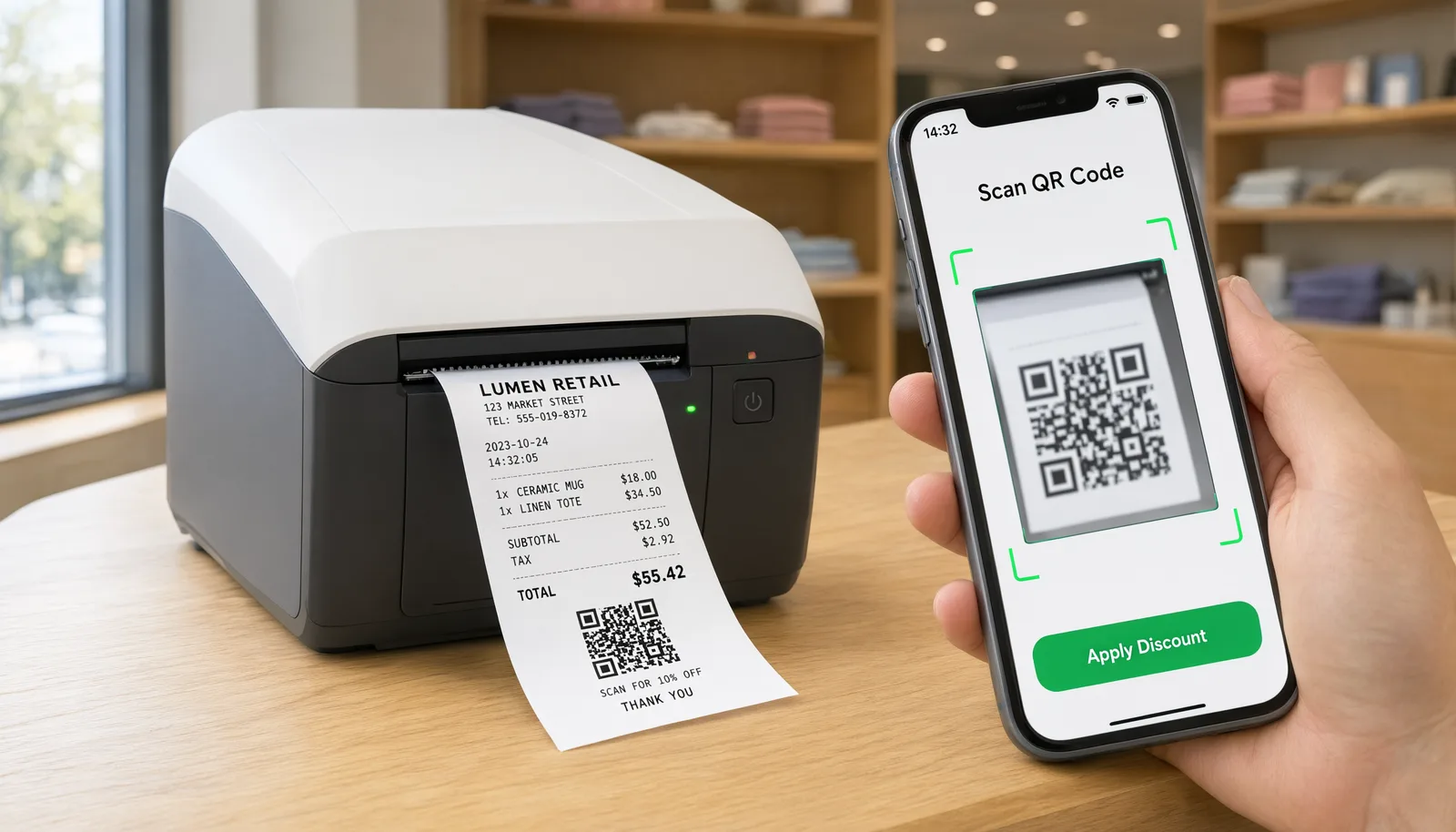
Electronic receipt requirements in 2026 at a glance
| Obligation | Reference rule | Operational detail |
|---|---|---|
| Logical POS-RT link | Budget Law 2025, paragraphs 74-77 | Registration on the Fatture e Corrispettivi portal; service active since 5 March 2026; deadline 20 April 2026 for POS already in use |
| Abbreviated receipt | Budget Law 2023 (Law 197/2022) | No paper receipt under €40 with at most 4 receipt holders per customer |
| Electronic receipt | Art. 1-bis DL 124/2019 (Budget Law 2021) | Delivered by QR code or SMS; revenue transmitted electronically like the paper receipt |
| Omitted recording sanction | Dlgs 471/1997 as amended by Budget Law 2025 | 90% of VAT on the transaction, minimum €500 per violation |
Sources: Agenzia delle Entrate and Sogei (documentation on the commercial document), Budget Law 2025 and Budget Law 2023.
What the electronic receipt is and how it works
The electronic receipt is the telematic version of the commercial document: instead of printing on thermal paper, transaction data are recorded in the telematic cash register and transmitted to the Agenzia delle Entrate. The customer receives the document in digital form, with a QR code or by SMS, and the revenue remains certified exactly as with the paper receipt.
The legal basis is art. 1-bis of DL 124/2019, introduced by Budget Law 2021: a merchant using enabled telematic systems can issue the document in electronic form. To be valid for tax purposes with tax code, the document must carry the customer's identification data, as the Sogei documentation on the electronic receipt also clarifies.
For the merchant the benefit is operational: no thermal paper rolls, faster cash closing and documents archived in the system. In fast-paced venues like bars, the combination of contactless terminals and digital receipts shortens the queue at peak times.
Who must issue it and who is exempt
The commercial document obligation concerns anyone selling goods or providing services to consumers through a telematic cash register. Some categories are exempt from the commercial document obligation: merchants who always issue an invoice, fuel sales, automatic vending machines and electric vehicle charging.
Since 1 March 2020 the stamp duty is handled by the automatic virtual mechanism: when revenue is transmitted telematically, the machine stamp no longer needs to be applied.
The paper exemption does not exempt from certification: revenue remains due and transmitted to the Agency even when the paper receipt is not printed. The customer can always request the document, at any amount, and the request must be satisfied.
The POS-cash register link from 1 January 2026
From 1 January 2026 an obligation directly connects electronic payments to certification: every POS terminal must be administratively linked to the telematic cash register, under art. 1, paragraphs 74-77, of Budget Law 2025, amending art. 2, paragraph 3, of Dlgs 127/2015.
The link is logical, not physical: it is recorded in the reserved area of the Fatture e Corrispettivi portal (service active since 5 March 2026) by associating the RT serial number with the POS identification data. The amount collected by card must match the revenue transmitted. For POS already active on 1 January 2026 the deadline was 20 April 2026; terminals activated later must be linked between the sixth and the last day of the second month after activation. Obligations, deadlines and procedure are described in the [mandatory POS and sanctions guide](/en/resources/payment-gateway-for-smes-guide).
Sanctions: how much you risk
Violations on revenue certification involve two sanction layers.
The first concerns refusal of electronic payment: since 30 June 2022 the sanction is €30 plus 4% of the transaction value, regardless of amount, with no settlement option (art. 15, paragraph 4-bis, DL 179/2012; DL 36/2022).
The second concerns revenue: failure to link POS and cash register is equated with omitted recording of revenue, with a sanction equal to 90% of the VAT due on the undocumented transaction and a €500 minimum per violation (Dlgs 471/1997, as amended by Budget Law 2025). With four violations in five years, business suspension from 15 days to 2 months is provided; if undocumented revenue exceeds €50,000, suspension can reach 6 months.
Electronic receipt and takings: the operational benefit
The electronic receipt does not change the fee cost, it changes efficiency: no paper, faster cash closing, digital archive. The line that weighs on the budget remains the per-transaction fee. With blended rates the amount is opaque (typically 1.4% to 1.95% by provider); with IC++ pricing every component is visible and verifiable: regulated interchange (0.2% debit, 0.3% consumer credit, EU Regulation 2015/751), scheme fee and markup.
RoxPay applies €0.15 + 0.35-0.85% (IC++) per transaction, with funds credited to the business account within 48 hours and VAT-number activation in 24 hours. The guide on [how much a POS costs](/en/resources/payment-gateway-fees-comparison) compares canoni and fees item by item over 12 months.
Frequently Asked Questions
Is the paper receipt still needed in 2026?
The paper receipt is not mandatory under €40 when the merchant uses at most 4 receipt holders per customer (Budget Law 2023, Law 197/2022). The customer can request it at any amount. Revenue certification always remains mandatory, with electronic transmission to the Revenue Agency.
What is the abbreviated receipt?
It is the reduced version of the commercial document, allowed for amounts up to €40 with at most 4 receipt holders per customer under Budget Law 2023. The document carries the essential data and the revenue remains transmitted electronically.
How does the electronic receipt with QR code work?
Art. 1-bis of DL 124/2019, introduced by Budget Law 2021, allows issuing the commercial document in electronic form: the customer receives it by QR code or SMS. The document has the same tax validity as the paper receipt when it includes the customer's tax code.
What are the sanctions if I do not issue the receipt?
Omitted recording of revenue carries a sanction of 90% of the VAT due on the undocumented transaction, with a €500 minimum per violation (Dlgs 471/1997 as amended by Budget Law 2025). Refusal of electronic payment carries €30 plus 4% of the transaction.
Must e-commerce issue the electronic receipt?
The online seller collecting from consumers must certify revenue with electronic transmission; those who always issue an invoice are exempt from the commercial document. The electronic receipt integrates with the e-commerce platform through the telematic cash register.
You might also like
High Risk Payment Gateway
Secure payment processing for high-risk industries with multi-acquirer routing and chargeback protection.
Small Business Payment Solutions
Transparent IC++ pricing, free Smart POS terminal, and 24-hour activation for small businesses.
E-commerce Payment Integrations
One-click plugins for WooCommerce, Magento, and PrestaShop with full API access.
Optimize your payments today
Discover the RoxPay POS for your business. No monthly fixed costs, transparent IC++ pricing. Contact us at /en/contact.
✓ No monthly fixed costs · ✓ Activation in 24 hours · ✓ Dedicated technical support