











Debit vs Credit Card: the Differences that Matter to the Merchant
The debit card debits the holder's account immediately; the credit card draws on a monthly credit line and charges at maturity. For the merchant the difference weighs on costs: regulated interchange is 0.2% on debit cards and 0.3% on consumer credit cards (EU Regulation 2015/751).
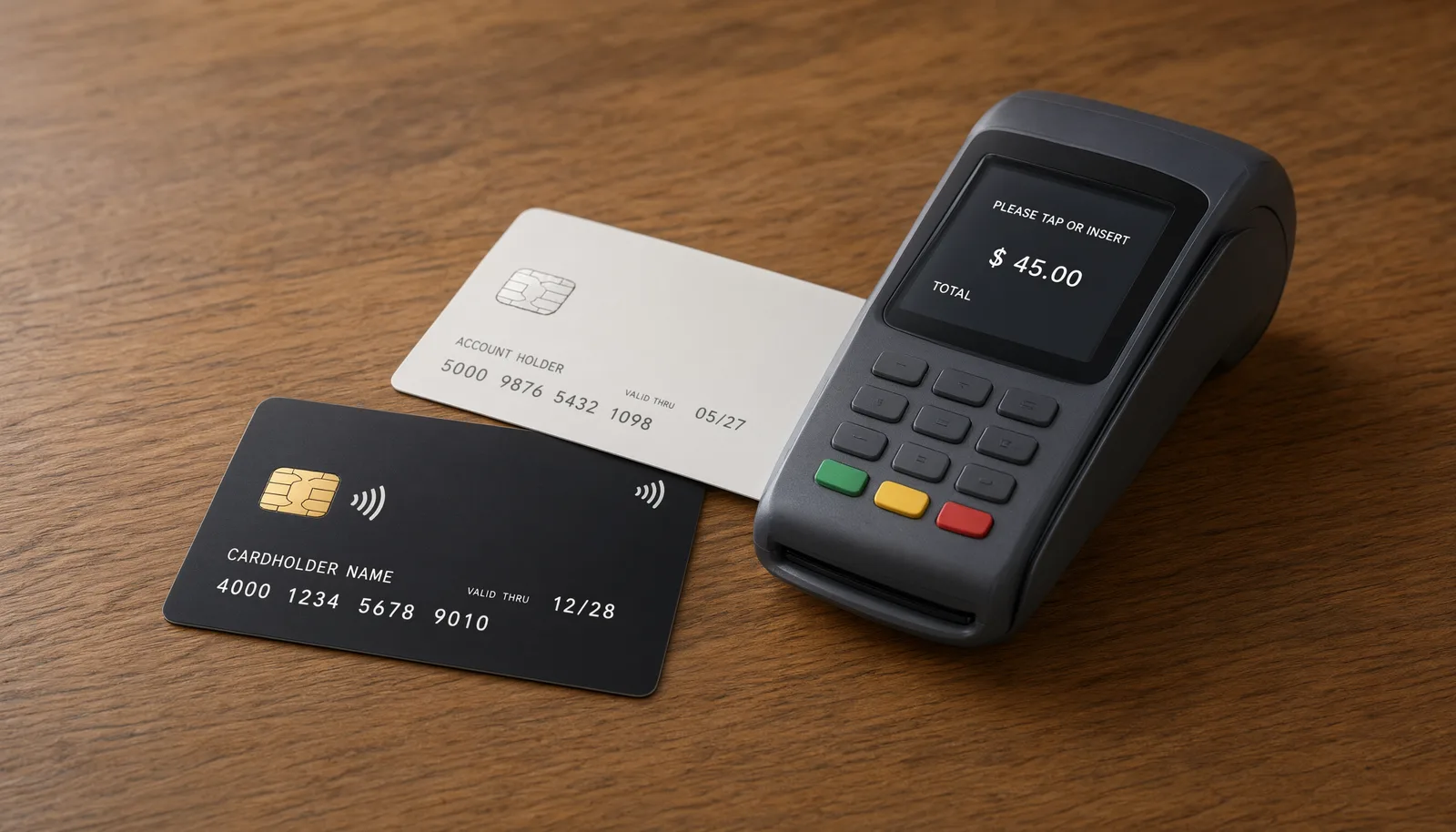
Debit vs credit: the differences that matter to the merchant
| Feature | Debit card | Credit card |
|---|---|---|
| RoxPay (IC++) | €0.15 + from 0.35% (EU consumer debit) | €0.15 + up to 0.85% (credit, corporate and international) |
| How the customer pays | Immediate debit on the bank account | Monthly limit, charged at the stated maturity |
| Consumer interchange (EU IFR) | 0.2% (EU Regulation 2015/751) | 0.3% (EU Regulation 2015/751) |
| Dispute windows | Scheme rules | Scheme rules, with typically wider windows |
Sources: EU Regulation 2015/751 (interchange), sector guides on cards. RoxPay does not issue cards: it is a payment gateway and accepts them; the variable component depends on the type of card presented.
Debit and credit card: how they work
The debit card is linked directly to the holder's bank account: when the customer pays, the amount is withdrawn immediately from the available balance. There is no limit or credit line: without coverage, the transaction is declined.
The credit card rests on a monthly limit granted by the issuing bank according to repayment capacity: the customer spends today and pays at maturity, with monthly statement charge or instalments per the contract. Sector guides on the topic report that the monthly spending cap is granted according to the holder's solvency.
There is also the prepaid card, loaded in advance: it spends only the loaded amount, with no link to the account. RoxPay issues none of these cards: it is a payment gateway that accepts them at POS and online.
Why the card type changes the merchant's cost
The fee the merchant pays has three components: the interchange (due to the issuing bank), the scheme fees and the provider's markup. European consumer interchange is capped by EU Regulation 2015/751: 0.2% for debit cards and 0.3% for credit cards.
The 0.1% difference looks small, but on high volumes it weighs. Above all: corporate cards and cards issued outside the SEE area do not fall under the regulated cap, so their interchange is free and higher. A mix weighted toward consumer debit is structurally cheaper than one with many corporate credits.
With blended rates (for example SEE cards at 1.5% + €0.25 per the public Stripe price list) the difference is invisible: the single percentage covers everything. With RoxPay's IC++ pricing (€0.15 + 0.35-0.85%) every component is separate: the lower bound corresponds to European consumer debit cards, the upper to corporate and international cards.
Operational differences at POS and in disputes
At the POS the transaction with debit or credit card is identical for the customer: contactless tap, chip or insertion. The flow changes on the bank's side: with debit the authorization checks the available account balance, with credit it checks the residual limit.
In case of dispute (chargeback) the windows and procedures depend on the schemes' rules, with windows for the holder typically wider on credit cards. The merchant should account for this in high-value sales: the [chargeback guide](/en/resources/payment-gateway-for-smes-guide) explains the documentary defences.
For the business clientele, where corporate cards with unregulated interchange prevail, the [B2B payments guide](/en/resources/b2b-payments-guide) shows how the instant transfer PIS cuts the cost versus cards on large invoices.
Debit, credit or prepaid: the quick guide
On the customer side, sector guides summarize: with a debit card you spend only the account balance; with a credit card you have a monthly limit repayable at maturity; with a prepaid card you spend only what you loaded. Each has different risks and costs for the holder (canoni, interest on revolving balance, top-ups).
For the merchant the question is different: how much the card mix weighs on the margin. The item-by-item math is in the [IC++ fee calculation guide](/en/resources/payment-gateway-fees-comparison), with examples on real volumes.
Frequently Asked Questions
What is the difference between a credit card and a debit card?
The debit card debits the holder's bank account immediately; the credit card uses a limit granted by the bank and the amount is charged at maturity, typically with the monthly statement. At POS and online both work the same way for the customer.
How much does a debit card cost the merchant versus a credit card?
Regulated interchange is 0.2% for debit cards and 0.3% for consumer credit cards (EU Regulation 2015/751). Corporate cards and those issued outside the SEE area fall outside the cap: their cost is higher. With RoxPay's IC++ pricing the variable component runs from 0.35% to 0.85% depending on card type.
Is the credit card safer for disputes?
Dispute windows and procedures depend on the schemes' rules, with typically wider windows on credit cards. In any case sales documents kept well are needed: the chargeback guide collects the operational documentary defences.
Does RoxPay issue credit or debit cards?
No. RoxPay is a payment gateway: it is not a bank, not a bank account and does not issue cards. It accepts debit, credit and prepaid cards at POS and online, with IC++ pricing (€0.15 + 0.35-0.85%) and credits within 48 hours.
Where does the prepaid card fit in?
The prepaid card is a third category: loaded in advance and spending only the loaded balance. For the merchant it works like a debit card at checkout; the fee depends on the scheme and card type, not on the fact it is prepaid.
You might also like
High Risk Payment Gateway
Secure payment processing for high-risk industries with multi-acquirer routing and chargeback protection.
Small Business Payment Solutions
Transparent IC++ pricing, free Smart POS terminal, and 24-hour activation for small businesses.
E-commerce Payment Integrations
One-click plugins for WooCommerce, Magento, and PrestaShop with full API access.
Optimize your payments today
Calculate how much your company saves with RoxPay's IC++ pricing versus the flat percentage. Talk to an expert at /en/contact.
✓ No monthly fixed costs · ✓ Activation in 24 hours · ✓ Dedicated technical support